
Paperback
ISBN
978-1-967642-17-5
Publisher
C5K Research Publication
Year
2025
Pages
22 pages
Language
en
Edition
1st
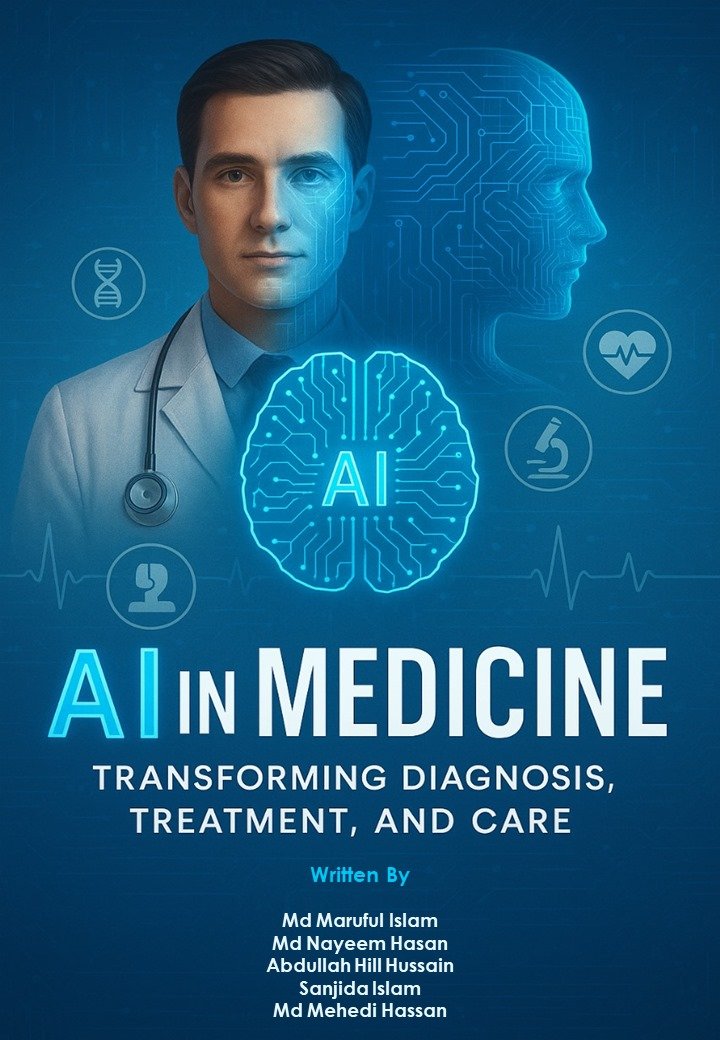
AI in Medicine: Transforming Diagnosis, Treatment, and Care
by Md Maruful Islam, Md Nayeem Hasan, Abdullah Hill Hussain, Sanjida Islam, Md Mehedi Hassan
About This Book
Rapid advancements in artificial intelligence (AI) are ushering in a transformational era for the healthcare sector. The practice, delivery, and experience of medicine are being transformed by what was formerly the purview of science fiction. AI is no longer an add-on to healthcare; rather, it is becoming a crucial component of its advancement, from optimizing administrative processes to directing robotic procedures, from real-time patient monitoring to highly customized treatment regimens based on genetic information. Medicine is a complicated, data-rich, and decision-intensive field by nature. Because of this, it is ideally equipped to take advantage of AI's processing capacity and pattern recognition abilities. The amount of data generated by wearable technology, pathology slides, genetic sequences, medical imaging, electronic health records, and even doctors' notes is too great for a single person to handle. With previously unheard-of speed and depth, AI technologies can mine this data to find insights, make predictions, and support decisions with ever-increasing accuracy. These skills are changing the standard of care, not merely improving the way healthcare is delivered. The promise of AI in medicine to close gaps in quality and access is among its most exciting features. AI-enabled diagnostic technologies can help frontline healthcare workers in low-resource environments by providing clinical decision assistance even when specialists are not available. Early treatments are made possible by predictive analytics, which can assist prevent issues before they worsen. A more fair, proactive, and patient-centered healthcare future is being heralded by the expansion of access to high-quality care to rural populations through AI-enabled telemedicine, remote monitoring, and mobile diagnostics. This change is not without difficulties, though. Technical, ethical, and regulatory issues become more prominent when AI is incorporated into medical practice. Transparency, algorithmic bias, and data privacy issues need to be rigorously addressed. Furthermore, it will be crucial to preserve confidence between patients, providers, and intelligent systems as AI grows more independent. Enhancing human judgment rather than replacing it should be the aim; AI should be used to support clinicians rather than to replace them.